FALLING SPERM COUNTS: A PROBLEM FOR HUMANITY
A possible explanation, worthy of investigation

Sperm counts are falling, wordwide
I just came across a well-written note, in “CHAT”, lamenting the worldwide reduction of human sperm production: The statement sounds ominous, but in actuality it doesnt go far enough: the truth is that the reduction in sperm production is not a major threat to human procreation, because, as has been said, “you only need one spermto fertilise an egg”. However it is accopmpanied by an even more worrisome situation among our females: ovulation is also down, and the rate of spontaneous abortion is rising.
It adds up to a reduction in the rate of population growth …… that’s good for the planet, perhaps, but it’s disconcerting for our “newlyweds”!
It’s not a new problem
As a Urologist, I am familiar with the problem of falling sperm counts, which was first noted in 1970, or thereabouts............ However my “take” on the subject lies rather in the realm of metabolic medicine, than in the Urology sphere.
SO, how bad is it, really?
My memory tells me that when I began residency in Urology in 1969, the average count was saif to be 120 Million per ml, but to be sure, I consulted “Copilot”, asking whether reports of average sperm counts, from 1040 onwards, exist.
Copilot responded:
“The Levine 2017 meta‑analysis—244 estimates from 185 studies, 42,935 men, found:
Mean sperm concentration (SC) declined 1.4% per year among Western men from 1973–2011, a 52% total decline.
Starting point (1973): ~99 million/mL (Western) - already less than I had been told!
End point (2011): ~47 million/mL (Western, unselected).
(These values come from the regression model reported in the study and only 1970s onward are evidence‑based. However the study provides a continuous slope, so we can derive approximate mid‑points:
Approximate sperm concentration in Western men, (Derived from Levine et al.).
1975: ~95–100M/ml
1985:~80M/ml
1995:~65M/ml
2005:~55M/ml
2011:~47M/ml
These values are approximations because the study reports slopes, not decade bins.
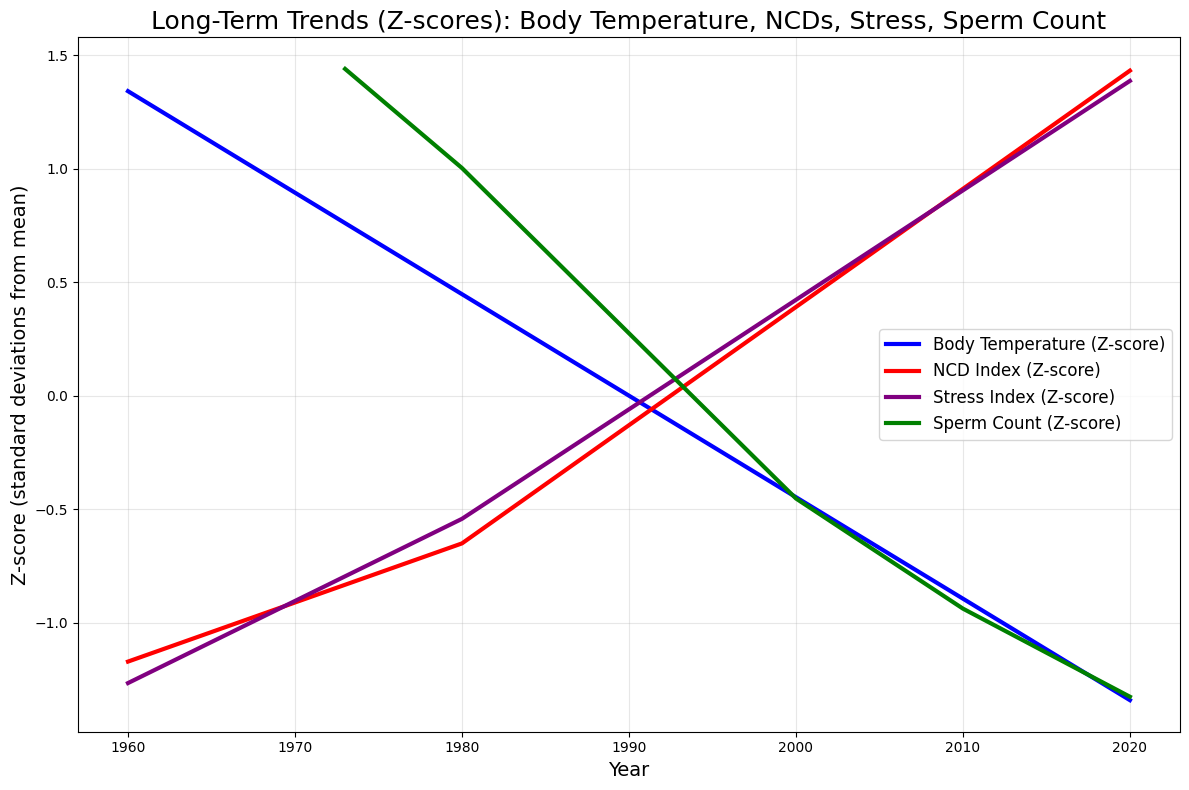
Anyway, my readers probably have the same problems in digesting rows of numbers as I do - a visual assist helps a lot - so here is a graph, which emphasises the point: as shown: increasing stress levels from the 1960s to 2020 have been accompanied by rising NCD (non-communicable disease) rates, while body temperature, and averge sperm counts have fallen. Both the loss of sperm production and the temperature change (due to plummeting brown fat activity) are direct effects of tissue hypothyroidism, which in turn is due to stress-related, Low Free T3.